Pages

Thursday, July 4, 2013

The First American “General” to Fall in Battle - Opechancanough (1646)


            Opechancanough, war chief of the Pamunkey tribal confederation, was commander of the unsuccessful half-century effort to expel the English colonists around Jamestown, Virginia. A talented strategist whose campaigns were marked by the inspired use of tactical surprise, especially furious surprise opening assaults, he was ultimately defeated by the superior weaponry of the invaders. Still, it was a remarkably close run struggle, marked by moments of high drama and touching the lives of people whose names are still remembered in elementary schools all over America.

            One such moment came in 1607. After a series of minor skirmishes, Opechancanough captured Captain John Smith who was freed following the entreaties of Pocahantas, the war chief’s niece. Several years later, in a symmetrical reversal of fortune, the Englishman returned the favor, freeing Opechancanough after taking his one-time captor hostage. Instead of calming the situation, these prisoner exchanges and other political gestures failed to prevent the first Anglo-Powhatan War. Waged from 1609-1614, the war concluded in a distinctly traditional way, with a “royal” wedding of Pocahantas to colonist leader John Rolfe. But deep resentments and affronts by both sides persisted, nor could Opechancanough forget his humiliating treatment at the hands of the English invaders.

            Warfare commenced anew on March 22, 1622 with a murderous surprise attack led by Opechancanough, already in his late sixties. More than 500 settlers – nearly one quarter of the entire colony population – were slaughtered in a single day. A low-level guerilla war, punctuated by several set piece battles and marked by savagery on both sides, then raged for almost fifteen years. Steady immigration from England offset the terrible losses of the settlers as the Native-Americans grew weaker. Eventually exhausted, Opechancanough sued for peace in 1635 and an uneasy truce followed for nearly a decade.

            On April 18, 1644, the old chief, now nearly 90 and carried into battle on a litter, mounted one final onslaught on the settlers. Although once again achieving tactical surprise and killing more than 300 settlers – another tremendous psychological blow to the English enemy - the Powhatan Confederation was not strong enough to consolidate its victory and by the end of the month the English captured the old man. In a spectacle reminiscent of the Roman treatment of enemy commanders, he was paraded through the streets of Jamestown and denounced as a “Bloody Monster” to the screams of those whose families had been killed in the war.

            Opechancanough, who had been a thorn in the side of the settlers for more than forty years, was imprisoned and in a still unexplained incident, murdered by one of his guards, the first “American” general to die as a prisoner of war. The strength of the Confederation was totally broken and the pattern was fixed for two and a half centuries of European expansion and displacement of the indigenous peoples in America by force of arms.

            A consummate practitioner of irregular warfare and skilled in the arts of guile, deception, and diplomacy, Opechancanough disappeared centuries ago from the annals of great American commanders. A battlefield leader who earned the loyalty of his warriors by sharing their hardships and risks, even in old age, and a careful planner, he was defeated by an insurmountable qualitative enemy advantage in weaponry and numbers. In spite of that, however, he came incredibly close to ending the English colonial penetration of Virginia very near its beginning and possibly changing the course of history on this continent.
 

Tuesday, July 2, 2013

The 10 Fallen Generals of Gettysburg (July 1 - 3, 1863)

15 Union & Confederate Generals Killed in Action or Died of Wounds

A few monuments on the battlefield ...


Maj. General John F. Reynolds, Corps 
 
Brig.-General Stephen W. Weed, Brigade

 Brevet Brig.-General A. Van Horn Ellis, Brigade
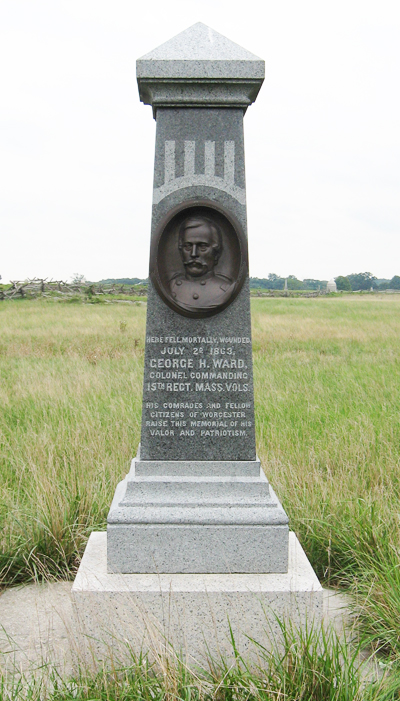
Brevet Brig.-General George H. Ward, Regiment

Brig. General Samuel K. Zook, Brigade


Brig. General Elon J. Farnsworth, Brigade

 Brig. General William Barksdale (CSA), Brigade

Brig. General Richard B. Garnet, (CSA), Brigade

Brevet Brig.-General Paul Joseph Revere, Regiment
Brig. General Strong Vincent, Brigade
Brig. General Lewis Armistead (CSA), Brigade

Brig. General Paul Semmes (CSA), Brigade


Brevet Brig.-General Louis R. Francine, Regiment

Brig. General J. Johnston Pettigrew (CSA), Brigade

Maj. General Dorsey Pender (CSA), Division

Monday, July 1, 2013

Fallen Stars - Introduction

         There is something unsettling and instructive about the story of a hero cut down at the instant of triumph or disaster. Perhaps what draws us to their stories is the purity of that instant – a frozen ideal - when there is no lingering possibility of diminution, error, or disappointment. The hero achieves immortality untouched by decay, the humbling forces of history, or the demeaning reality of personality flaws. We see them forever young, or old, covered in glory - or folly. From the actions and examples of these fallen leaders we continue to draw inspiration and lessons about command, heroism and leadership.

Because of the pathos of the hero’s ending, the focus is usually fixed on actions that uplift, that stir the spirit, that give expression to our own highest, often unspoken, aspirations for courage in the face of great danger. In short, these stories are natural fodder for propaganda. Or, conversely the example leaves us disappointed, or depressed by the stupidity or folly of a fruitless sacrifice, the waste of a noble, but forlorn demonstration. In that case, the story is seldom told.

Whatever the circumstances, it is difficult to overstate the value of such lessons; there is no more important, or necessary, civic virtue for the preservation of our republic than battlefield courage and the resolve at home that sustains it. The fact that commanders die in battle draws the bonds among warriors, leaders, and citizens tighter, and that, at the root, that danger is shared in an instant by all.

Over more than two centuries of our history, some 225 generals and admirals have been killed in action, about one for each year of our freedom. It is not a large number compared to other nations. Our highest loss occurred during the Civil War, 160 generals, split equally between North and South. During Gettysburg, alone, 15 generals on both sides fell. The Global War on Terrorism – already the longest conflict in our history - has cost America one general killed in battle so far, maybe one more. Among the names on the list of generals killed are some famous Americans – George Armstrong Custer and “Stonewall” Jackson - but the names and stories of most have been lost.

Also lost in our history are the stories of smaller conflicts, e.g. the War of 1812 and the many campaigns against Native-Americans – the US Army’s first experience of irregular warfare – as well as other equally controversial campaigns, like the Mexican War, Boxer Rebellion, the Philippine American War, or Vietnam. In the past, the dramatic deaths of battlefield leaders focused the nation’s attention on those struggles and this series will try to do the same.

An especially compelling and appealing feature of the study of fallen heroes is that it stands apart from the passions of the present moment which inevitably divide us. In times of intense political controversy – like the present - when issues of war and peace exacerbate our normal partisan differences, there is little difference of opinion about the heroism of the defenders of our freedom, or the altruism of their service. An act of courage and self-sacrifice is by its nature separate and independent of nations, governments, or political parties. To adapt a familiar observation, ‘there are no democrats or republicans in foxholes.’

Fallen Stars will recount and rescue the most dramatic stories of our forgotten heroes and conflicts from obscurity. Each of us can then marvel, not just at the valor and courage of ordinary citizens - our friends, relatives and neighbors - but also at the heroism and sacrifice of those who were appointed to lead them on the battlefield.

If a single American general dies in Afghanistan, or in the War on Global Terrorism, especially in heroic circumstances, the interest in Fallen Stars will soar. There is no reason to think that we harbor any less fascination with celebrated heroes as in any previous period of mass media interest in far away wars. Just look at the impact of the death of a single ambassador in what used to called the “Barbary Coast.”